
Paradoxes in medicine represent very interesting counter-intuitive clinical observations where outcomes or phenomena contradict conventional expectations from logical thinking. These paradoxes provide amazing insight into human physiology.
Obesity Paradox
The obesity paradox refers to observations that overweight or mildly obese patients with certain chronic illnesses (like heart disease) may have better survival rates than those with normal weight. This occurs likely due to protective metabolic reserves and better nutritional status in these patients despite obesity's typical risks.
Y-Y Paradox
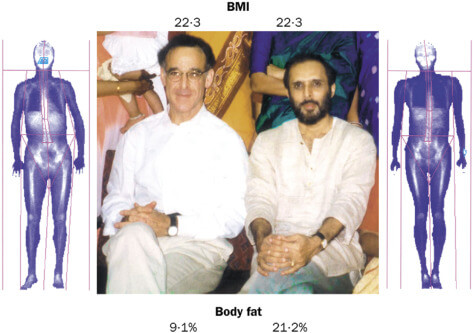
The Y-Y paradox refers to the observation that individuals with normal BMI can be obese. This is due to different fat distribution among individuals.Yajnik and Yudkin had nearly identical BMIs (around 23-24, in the "normal" range) but dual-energy X-ray absorptiometry (DEXA) scans revealed Yajnik had substantially more body fat than Yudkin. Yudkin, an avid marathon runner, had more lean muscle mass, while Yajnik's lifestyle (less intense exercise) contributed to his higher fat percentage despite the matching BMI.
Pulsus Paradoxus
Pulsus paradoxus is an exaggerated decrease (>10 mmHg) in systolic blood pressure during inspiration. The paradox lies in the patient's pulse being absent despite a heartbeat being audible, due to increased intrathoracic pressure changes affecting heart filling.
Paradoxical Breathing in Flail Chest
In flail chest, a chest wall segment moves inward during inspiration and outward during expiration, opposite the normal chest movement. This paradoxical motion is caused by multiple rib fractures detaching a rib segment that no longer moves synchronously with the rest of the chest.
Smoking Paradox
The smoking paradox describes the counterintuitive finding that smokers develop acute coronary syndrome at younger age, but have better outcomes than non-smokers.. This is due to prior mild ischemia making better tolerance of ACS by preconditioning.
Sex Paradox in Pulmonary Hypertension
Women are more likely(high risk) to develop pulmonary arterial hypertension (PAH) but tend to survive longer than men with the disease. This paradox likely involves complex hormonal and genetic factors influencing disease susceptibility and treatment response.
Paradoxical Undressing in Cold Death
Paradoxical undressing is a phenomenon where victims of severe hypothermia remove their clothing despite freezing temperatures. It occurs because of vasodilation caused by failure of vasoconstrictor muscles, creating a sensation of overheating and confusion.
Paradoxical Aciduria in Congenital Hypertrophic Pyloric Stenosis (CHPS)
Paradoxical aciduria occurs in chronic CHPS where, despite metabolic alkalosis, the kidney excretes acid instead of alkali due to hypochloremia-induced sodium retention that drives hydrogen ion secretion in the distal nephron.
Paradoxical Reflex
In a paradoxical reflex, the response is opposite to the expected movement (e.g., extension instead of flexion).It occurs due to loss of cortical inhibition after an upper motor neuron lesion, releasing primitive reflex pathways. For example, in a paradoxical brachioradialis reflex, tapping the radius—normally causing forearm flexion—instead produces forearm extension.
Ulnar Paradox
In ulnar nerve injuries, paradoxically, a more distal injury causes more severe claw hand deformity than a proximal injury, because the key muscle involved is the flexor digitorum profundus (FDP) — specifically, the medial (ulnar) half that flexes the distal interphalangeal (DIP) joints of the ring and little fingers. When the ulnar nerve lesion is higher the FDP is also paralyzed → less clawing (because the DIP joints can’t flex).When the lesion is lower, the FDP is spared → more clawing.
Immune Paradox in Sarcoidosis
Sarcoidosis exhibits an immune paradox where there is intense localized inflammation in affected organs characterized by granuloma formation yet systemic anergy, meaning patients show poor immune responses to common antigens. This paradox arises because of an imbalance between effector T cells causing inflammation and regulatory T cells which suppress immune responses, leading to simultaneous inflammation and peripheral immune suppression.
Treatment Paradox in Sarcoidosis
The treatment paradox refers to the observation that immunosuppressive treatments like corticosteroids and anti-TNF agents can effectively reduce sarcoidosis inflammation but paradoxically may trigger sarcoidosis-like granulomatous reactions.Additionally, some patients do not respond to standard therapies despite active disease, highlighting complex, paradoxical effects of treatment on immune regulation.
Paradoxical Kinesia in Parkinson Disease
Paradoxical kinesia describes patients with Parkinson's disease who temporarily regain voluntary movement fluency during emergencies or emotional stimuli, despite their chronic motor impairment. Author from the book Sapira mentions an incident when a parkinson patient runs from hospital to save his house from fire and then again returns back to hospital with slowing of movements.
Paradoxical Pupil Dilation (Relative Afferent Pupillary Defect, RAPD)
RAPD or paradoxical pupil dilation occurs when the affected eye's pupil dilates instead of constricting in response to light, indicating optic nerve or severe retinal disease that disrupts normal afferent signaling.
Peto Paradox
Peto paradox notes that larger animals with more cells do not have higher cancer rates than smaller animals, contrary to expectations. It suggests evolved cancer suppression mechanisms in large, long-lived species. For eg: Elephants and Blue whales rarely get cancer!

Paradoxical Emboli
Paradoxical emboli occur when emboli originating in the venous system bypass the lungs (through abnormal cardiac shunts like patent foramen ovale) and enter systemic circulation, potentially causing arterial embolic events like stroke.
Image Sources:
- The Y-Y paradox,Yajnik, Chittaranjan S et al.,The Lancet, Volume 363, Issue 9403, 163
- Kurzgesagt Youtube Channel